
Animal MRI Explained: Why It’s Recommended and What to Expect
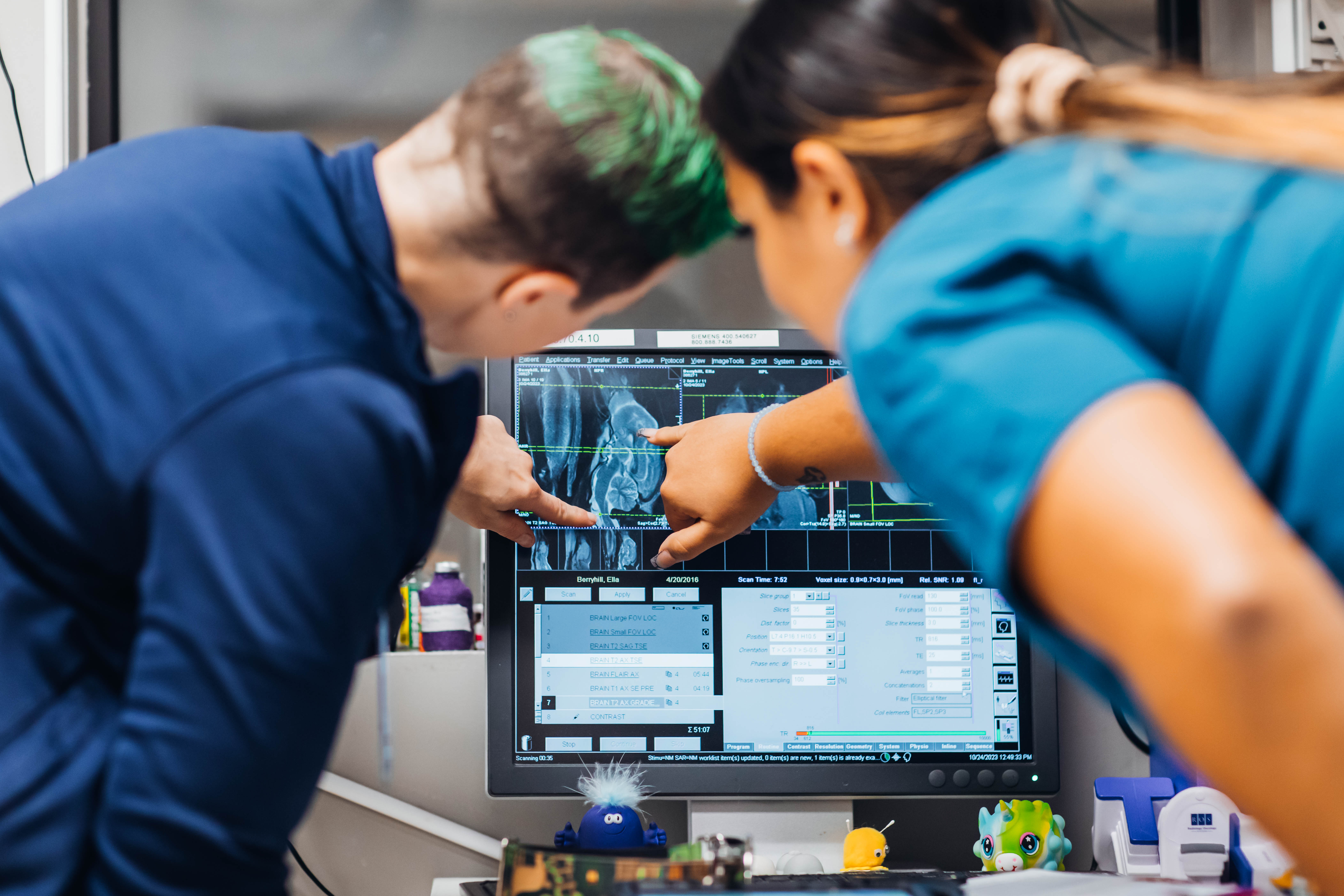
What is an MRI?
An MRI is a large piece of equipment that uses magnets to create images of the body. The magnets stimulate water molecules (protons or hydrogen atoms) inside the body. Normally protons are spinning around randomly. When the magnet is active, it causes the protons to line up in straight lines. The MRI machine then emits radio waves that interact differently with the protons causing them to spin again. When the radio wave turns off, the protons will start to line up again and, in this process, they emit energy which is recorded by the machine and converted into an image.
Is MRI safe?
MRI, unlike x-ray or CT scan, does not use radiation to create images. The magnets in the MRI however are very powerful and if your animal has metal in their body (prior surgery, implants, microchips, etc.), the metal can move inside the machine if it is attracted to the magnet, just like a strong refrigerator magnet. The MRI machine is very loud so ear protection (headphones, ear plugs, cotton balls) are often used to limit exposure to loud sounds. This is also part of the reason that dogs and cats need to be under general anesthesia for an MRI.
Be sure to tell your veterinarian if your dog has had prior orthopedic surgery or otherwise may have metal inside their body. Pre-MRI x-rays of the chest and/or abdomen may be used to screen for metal pieces as well as ensure there are no changes in the heart or lungs that would make anesthesia dangerous.
How long does an MRI take?
An MRI may take anywhere from about half an hour to several hours depending on the size of your animal, the area(s) being scanned, and the abnormalities identified. To scan an entire dog from nose to tail could be three hours or more. Animals are usually monitored after MRI for at least an hour to ensure they recover well from anesthesia.
Why is anesthesia required for an MRI for my animal?
In order to get good quality images, any animal inside an MRI machine must be perfectly still. Movement will create artifacts and distortions that make it difficult to interpret the images. As mentioned above, the MRI can take a long time, during which the animal must be completely still the whole time. In addition to this, there are the loud noises of the machine itself that can be scary for animals. For these reasons, general anesthesia is used to keep your animal still for the MRI while also maintaining airway protection and ensuring their safety. MRI safe monitoring equipment is used so that your animal’s heart and lungs are closely monitored while they are asleep.
Although general anesthesia is used for MRI, MRI is non-invasive, so the depth of the anesthesia is lighter than that needed for surgery. There are risks with general anesthesia including nausea, sore throat, breathing problems, and pneumonia. We try to minimize some of these by fasting animals (no food) for 8-12 hours prior to anesthesia. In sick animals, their illness may also contribute to additional types of risk. For example, animals with kidney disease may have worsening of their kidney function if their blood pressure drops too low during anesthesia. This is why veterinarians recommend blood work prior to anesthesia and MRI.
Why might my animal need an MRI?
MRI is most used for taking pictures of the nervous system (brain and spinal cord). It can be used for evaluating ears, noses, and joints (knees/elbows). MRI is less commonly used for imaging the heart and lungs due to the constant motion of these tissues (remember, we need stillness for the MRI to work).
MRI is therefore recommended most often by neurologists who are examining animals with seizure disorders, neck pain, back pain, and/or difficulty walking.
Is MRI better than CT?
Because the images produced by an MRI or CT are created differently, the information provided is complementary. MRI is not necessarily better than CT or vice versa. MRI does however provide greater detail for soft tissues, which is why it is preferred for the brain and spinal cord and for looking at certain types of cancers. CT, which uses x-rays, takes much less time and can be valuable in animals that are not good anesthesia candidates.
Will my animal be normal after the MRI?
Animals may be groggy for 12-24 hours after anesthesia for MRI. During this time, it is recommended to keep them away from stairs or high furniture to avoid falls. Because IV fluids are given during the MRI you may notice that your animal is urinating more than usual. Your animal may have a slight cough for 1-3 days due to the breathing tube that was used for anesthesia. Lastly, expect to see shaved patches on your dog. These are areas that were clipped to make it more sanitary for an IV catheter or for monitoring equipment to be placed.
When will I get my results?
The veterinarian caring for your animal is often able to see the MRI in real time and provide you with preliminary results. In some situations, your animal’s MRI images may be sent out for review by a board-certified radiologist or neurologist. These results may take 48-72 business days.
Reviewed by Samantha Vitale, DVM, MS, DACVIM (Neurology)
Articles by Specialty
- Cardiology (19)
- Large Animal Internal Medicine (23)
- Neurology (19)
- Oncology (22)
- Small Animal Internal Medicine (29)
Articles by Animal
- Cats (35)
- Dogs (52)
- Farm Animals (5)
- Horses (12)